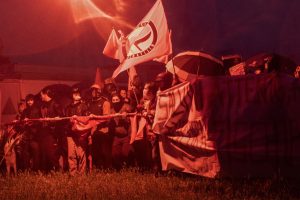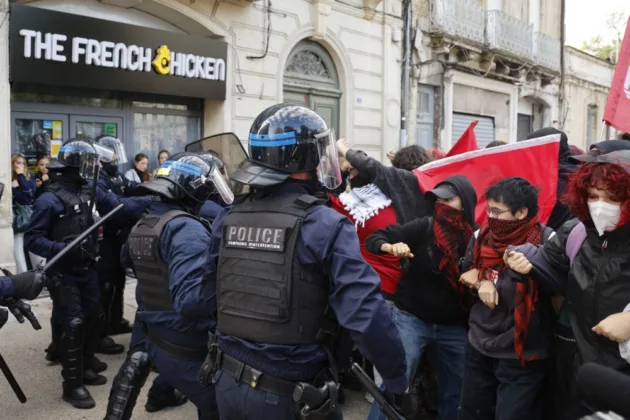
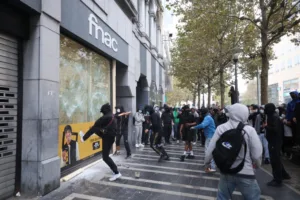



Belgium’s interior minister has said the student riots in Liège, eastern Belgium, are no longer a spontaneous school protest, and that an Antifa-type movement is manipulating children.
Bernard Quintin, of the liberal Mouvement Réformateur (MR), said it at a press conference on the morning of October 8, after a third night of broken glass, fires and looting in the city centre.
“We know that there is a movement, of the Antifa type, active in Liège,” he said.
“Adults who manipulate children in order to put across violent political messages. That is totally unacceptable.”
The spontaneity, he added, had gone. The movement had been “infiltrated”. Parents and schools, he said, bore part of the blame. On X he called the damage “facts of extreme gravity” and wrote: “Vandals? They pay. Full stop.”
Jean-Marc Demelenne, the Liège police chief, said on October 8 that since October 1 there had been “a continuous increase in the violence, but also an increase in the number of rioters”, and that “in recent days these are profiles that have nothing to do with the pupils”.
An increasing number of rioters are reportedly adults. Minors accounted for about 70 per cent of those detained up to October 6, but only around half of those held on October 7, according to Demelenne.
For days now, student protests around Liège have escalated into violence. Shops in the centre have been looted and the manager of the games retailer Smartoys put the stock taken from his store at about €30,000. Twenty-two police officers were injured on October 5 alone, the Liège public prosecutor’s office said, adding that violence and damage would meet “a systematic criminal response”.
Liège police said 87 people were held on October 7, 79 administratively and eight judicially.
Since October 1, the running total of detentions in the city is close to 200, most of them minors, answering calls sent on messaging apps. Among them was a boy of 13, held after calling on social media for a school to be set on fire.
The mayor, Willy Demeyer, has banned gatherings of more than three people on the street from 6am on October 8 until 11.59pm on October 16. Households, minors accompanied by an adult and people travelling to or from school, sport, shops or restaurants are exempt.
On October 7 the BE-Alert system told shopkeepers to shut: “Major unrest is under way.”
Showmen at the local fair, some with iron bars, faced the rioters. Trams in the centre were stopped.
La ville de Liège après les manifestations. pic.twitter.com/3Q4yrBGqMK
— Jon De Lorraine (@jon_delorraine) October 8, 2026
The grievances the pupils cite are the risen registration fees in the French-speaking community, for many students to €1,194 from €835.
Grant-holders still pay nothing, though, and reduced bands remain at €374 and €835. About 60 per cent of students pay the top rate, according to the magazine Moustique. Costs in Belgium’s French-speaking community are still low by Dutch (€2,694) or English (£9,790, about €11,200) standards.
Together with the higher registration fees, the annual youth bus pass on the Letec network is due to jump from €12 to €384 on February 1, 2027. That figure is for the whole-network Express pass for 12- to 25-year-olds; a €180 pass still covers every other line.
Students in Liège told Reuters the French school blockades had “influenced us a little”, but claimed their problems stand on their own.
Liège already had a named Antifa scene.
On September 10 masked militants vandalised the offices of media outlets La Meuse and RTL during a teachers’ march, with Antifa stickers and anarchist tags.
On September 24 seven or eight masked people burst into a lecture by professor Damien Ernst at the University of Liège, pelted him with cakes and called him a “facho” and a “Thales collaborator”, objecting to his work on artificial intelligence for defence.
The action was claimed by a group styling itself the university’s “people’s ethics committee” and was relayed by the Fronde liégeoise antimilitariste and the Front antifasciste de Liège. Theo Francken, the defence minister, called it proof that “Antifa is becoming more violent by the day”.
Voici les images de l’agression subie par le Professeur @DamienERNST1, en plein cours, à l’@UniversiteLiege.
Cette attaque contre la liberté académique est revendiquée par la même mouvance #antifa liégeoise qui s’en était déjà pris à @GLBouchez l’année passée.
La gauche a le… https://t.co/9irgJpqwMU pic.twitter.com/rkVcclNuRJ
— Roger The Shame 🥇🥇 (@RogerTheShame) September 24, 2026
On the Left, arguments are often made that Antifa is “only an idea” and not a real organisation, though Western governments have begun to treat it as something more.
In August the US State Department sanctioned Autistici/Inventati, an Italian collective, for building encrypted tools used by Rose City Antifa and by left-wing cells in France, Italy, Germany and the Netherlands, including to claim railway attacks.
The researcher known as Data Republican, Jennica Pounds, indexed the collective’s Noblogs platform and found a shared archive of left-wing and Antifa sites across the United States and Europe, with doxxing posts carrying names and addresses.
In July US Secretary of State Marco Rubio launched an international initiative to elevate violent left-wing extremism to a global counterterrorism priority, arguing that governments have spent decades focusing on Islamist and right-wing threats while overlooking a growing wave of politically motivated attacks by left-wing militants.
Journalist @AssarChristian alleges the Anarchist Black Cross funds terrorists, backs Antifa attacks, and writes letters to convicted extremists, all under the guise of ‘solidarity'. pic.twitter.com/0DoGhhpBEg
— Brussels Signal (@brusselssignal) December 13, 2025