





The Irish presidency of the Council of the European Union has put forward a revised negotiating box for the Multiannual Financial Framework (MFF) covering 2028-2034, trimming the European Commission’s original proposal by 8 per cent, or about €141 billion.
The proposal, circulated on October 10, sets total commitments at roughly €1.62 trillion in 2025 prices, or about €1.83 trillion in current prices.
This represents a 30 per cent increase on the current 2021-2027 MFF and equates to 1.16 per cent of EU gross national income (1.05 per cent excluding NextGenerationEU debt repayment).
The Commission’s July 2025 proposal had been framed as “almost €2 trillion” (around €1.76 trillion in 2025 prices, or 1.26 per cent of GNI).
Cuts are uneven. Spending on cohesion, agriculture, fisheries and rural communities — the largest traditional headings — is reduced by about 3 per cent relative to the Commission figures, to €914 billion, protecting politically sensitive national allocations.
Competitiveness, prosperity and security programmes face a steeper reduction of around 13 per cent, to €456 billion, while Global Europe (external action) is cut by roughly 17 per cent, to €157 billion. Administration is reduced by 8.8 per cent, to €95 billion.
Even after these adjustments, the Irish text doubles competitiveness-related funding compared with the current MFF, with research, innovation and defence the fastest-growing part of the package.
It also retains a package of new own resources expected to raise about €55 billion a year, drawing on sources such as customs duties, a share of ETS auction revenues and a contribution from large companies.
The presidency would lift the EU’s call rate on revenues from the carbon border adjustment mechanism from 75 per cent to 90 per cent and allow the EU to keep 90 per cent of the customs duties collected at its borders.
Three revenue sources favoured by the European Parliament — a digital services levy, an online gambling levy and a charge on crypto-asset gains — are absent from the text.
The text is positioned as a compromise between “frugal” net-contributor states (led by Germany and including the Netherlands, Sweden, Austria and Finland), which want deeper cuts, and the larger group of member states that prioritise protecting the Common Agricultural Policy and cohesion policy.
Ireland’s Minister of State for European Affairs and Defence Thomas Byrne said the box “acts to bridge the many differences between the member states” and brought the EU closer to resolving what he called the budgetary trilemma.
European Council President António Costa has pushed for a deal by the end of 2026.
EU ambassadors examined the text on October 11 and European affairs ministers are due to debate it at the General Affairs Council in Luxembourg on October 13, before leaders take it up at the European Council in Brussels on October 15-16.
The European Parliament’s lead MEPs on the MFF have rejected the text as a starting point, arguing that an 8 per cent cut to an already constrained Commission proposal would weaken the EU’s capacity on competitiveness, defence and other priorities.
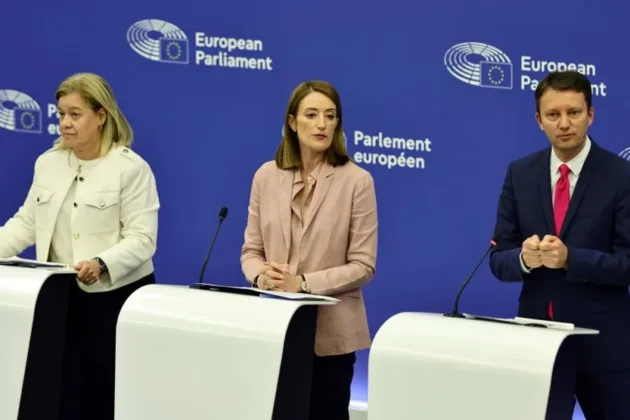
Co-rapporteurs Siegfried Mureșan and Carla Tavares, with own-resources co-rapporteurs Danuše Nerudová and Sandra Gómez López, said in a joint statement that “cuts that weaken Europe will not get our consent”.
They have previously called for an increase of around 10 per cent above the Commission’s figures, in the negotiating position Parliament adopted in April.
Parliament’s consent is required before an MFF can enter into force, giving MEPs a veto over the final package.
The negotiations take place against a backdrop of continued high error rates in EU spending.
The European Court of Auditors’ annual report for 2025, published on October 8, estimated that 3.8 per cent of audited expenditure was affected by error — up from 3.6 per cent in 2024 and above the auditors’ 2 per cent materiality threshold.
The audited population came to about €130.8 billion.
Error rates were highest in cohesion spending, at 6.6 per cent, and in agriculture and environment, at 3.9 per cent, up from 2.6 per cent a year earlier.
The ECA issued an adverse opinion on the regularity of spending for the seventh consecutive year.
The auditors also recorded EU debt of €738.9 billion at the end of 2025, against €601.3 billion a year earlier, with borrowing on course to approach €1 trillion by 2027. ECA President Tony Murphy said the common borrowing amounted to “real debts, which have to be paid back”.
The Commission has long argued that the EU needs a larger budget to fund defence, competitiveness, green and digital transitions and other new priorities, while also servicing NextGenerationEU debt.
The European Public Prosecutor’s Office is investigating more than 500 cases of suspected fraud linked to the European Union’s €577 billion Recovery and Resilience Facility, the bloc’s flagship post-pandemic stimulus fund. https://t.co/yPDKg433e6
— Brussels Signal (@brusselssignal) March 2, 2026