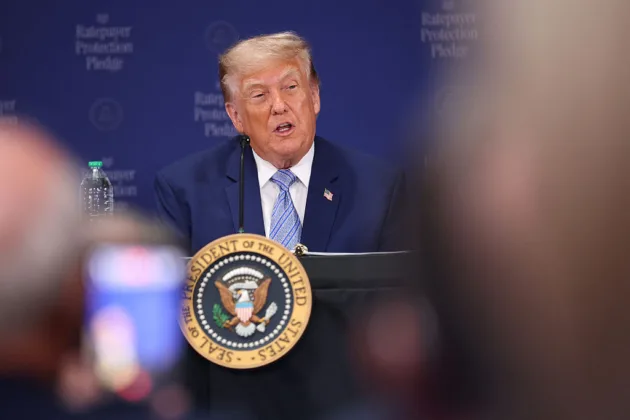










US President Donald Trump has submitted a civil nuclear cooperation agreement with Saudi Arabia to Congress while maintaining that the pact will not proceed unless Riyadh joins the Abraham Accords.
The document reached Capitol Hill on August 24 as required by the Atomic Energy Act, according to an administration official who spoke to Reuters on condition of anonymity.
The same official said the accord “will only move forward if Saudi Arabia joins the Abraham Accords”, the framework under which Israel established relations with the United Arab Emirates, Bahrain, Morocco and Sudan during Trump’s first term. Sudan has yet to ratify it.
Congress now has 90 days of continuous session to examine the text. Unless lawmakers pass a joint resolution rejecting it, the agreement takes effect without a vote in either chamber.
The entire document has been classified, which is unusual for what are known as 123 agreements. Previous civil nuclear pacts were published, though some carried classified annexes that were withheld.
Energy Secretary Chris Wright signed the accord with his Saudi counterpart, energy minister Prince Abdulaziz bin Salman, on July 22. Trump attached the Abraham Accords condition the following day in a post on his Truth Social platform, a requirement absent from the text the two sides had agreed.
In that post the US President also wrote: “There will be no enrichment of material!” Reporting on the deal has indicated it leaves open a route to enrichment inside the kingdom, through an American-built and American-operated plant subject to a two-year feasibility study.
Democratic lawmakers and arms control specialists have criticised the absence of a permanent ban on enrichment and reprocessing, and the omission of the International Atomic Energy Agency’s Additional Protocol, the enhanced inspection regime the United Arab Emirates accepted in 2009.
The 30-year agreement would open the kingdom to American reactor exports and calls for the construction of AP1000 units, a programme worth tens of billions of dollars to Westinghouse. Without a 123 agreement, US firms had been shut out of a market contested by French, South Korean, Russian and Chinese suppliers.
Riyadh has demanded an irreversible path to Palestinian statehood before recognising Israel, and Crown Prince Mohammed bin Salman has repeated that position publicly.
The submission has come as Washington’s war with Iran, fought in large part over Tehran’s own enrichment, keeps the Strait of Hormuz disrupted and European energy bills elevated.
Israeli Prime Minister Benjamin Netanyahu welcomed the condition in July, his office describing Saudi accession to the accords as “an historic leap forward for peace”.