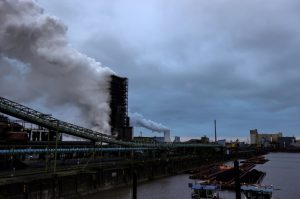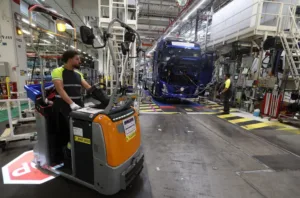





Nearly 30 per cent of factory machinery across Belgium has stood idle in recent months, with the manufacturing sector’s production capacity tumbling to its lowest level since the onset of the COVID-19 pandemic.
According to data compiled by the National Bank of Belgium (NBB) and reported by financial dailies De Tijd and L’Echo, industrial capacity utilisation slumped to an average of just 73 per cent during the third quarter of 2026.
The figures mean 27 per cent of all production equipment across the country is currently inactive, a level not recorded since April 2020, when pandemic lockdowns shuttered much of the European economy.
Since the NBB began measuring utilisation in the late 1980s, only four quarters have produced a weaker reading, all of them during the 2009 financial crisis and the pandemic shutdowns. The third-quarter figure sits almost four percentage points below the 2021-2025 average.
Belgian industry also lags the European norm: capacity utilisation across the EU stood at 77.9 per cent in the third quarter, according to the European Commission’s business survey.
The slump has sparked alarm among industry representatives, with metal and technology federation Agoria describing four years of utilisation below 80 per cent in its sector as “unprecedented” and warning that prolonged stagnation will trigger further job losses.
Belgium’s technology industry has already shed 20,000 jobs over the past three years alone, representing a 6 to 7 per cent contraction in productive capacity compared with pre-crisis levels.
The contraction is sharpest in Wallonia, where only 67.1 per cent of available capacity is being used, more than 10 percentage points below the region’s 10-year average. In Flanders 75.3 per cent of the available capacity is being used, 1.3 points below its own long-term benchmark.
The steepest falls have come in the metal industry, iron and steel processing, building materials and machinery, where utilisation has dropped well below the levels of recent years.
“In our sector, we have been struggling with an occupancy rate below 80 per cent for four years now. That is unprecedented,” Agoria chief economist Patrick Slaets told public broadcaster VRT NWS.
“The cause lies in a lack of demand. There is insufficient investment, driven by the high interest rates that inflation brings with it, and excessively high energy costs due to the geopolitical situation,” Slaets explained, adding that energy-intensive manufacturers have borne the brunt of the shock.
The sustained drop in capacity utilisation poses an immediate risk to the industrial workforce. As Slaets said, “If the machines are not running, there is no need for people to work at them.”
He warned that Belgium could slide into an industrial recession next year unless wage costs were brought into line with those of neighbouring countries.
Factory output has suffered from a sustained contraction in demand, exacerbated by high interest rates, persistent inflation and elevated energy tariffs.
Belgium’s manufacturers have also faced acute pressure from high domestic labour costs linked to the country’s automatic wage-indexation system, leaving local firms vulnerable against international competitors.
Sectoral federations have urged policymakers to enact urgent cost-cutting and regulatory relief measures.
European chemical capacity fell by 9 per cent between 2022 and 2025, according to consultancy Roland Berger, and what remains is running at 69 to 70 per cent. In Tessenderlo-Ham, Limburg province, northeast Belgium, producer Vynova suspended output over energy prices, leaving 600 workers facing temporary unemployment.
Chemical industry federation Essenscia spokesperson Gert Verreth said the current crisis cut deeper than the previous one, pointing to high energy costs and bureaucracy. He said European politics was moving too slowly.
Business leaders caution that without structural reforms to energy pricing and labour costs, idled machines risk becoming permanent closures across the heart of Belgian manufacturing.
Energy-hungry industries in Europe are effectively “dying” as rising energy prices, the flood of cheap goods from China, and climate policy make survival increasingly difficult, according to the National Bank of Belgium. https://t.co/v4ZJzH7Vnk
— Brussels Signal (@brusselssignal) November 14, 2025